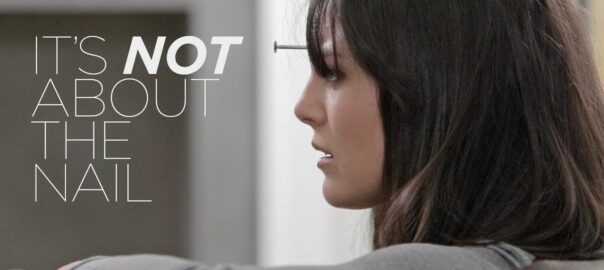
There’s a short film called It’s Not About the Nail that cracks me up every time. A woman is explaining to her partner how she has this terrible pressure in her head, how all her sweaters keep getting snagged, how nothing seems to be going right. And the whole time, there is a nail sticking out of her forehead. He tries to point it out. She says, “It’s not about the nail.”
If you haven’t seen it, go ahead and watch it. It’s two minutes long and it’s hilarious. Also painfully accurate.
Here’s the thing: we all have a nail. And most of us have gotten really good at explaining why our headaches have nothing to do with it.
What is denial, really?
The official definition from recovery circles goes something like this: a false system of beliefs not based on reality and a self-protecting behavior that keeps us from honestly facing the truth.
My own definition is simpler:
the optionally-conscious overlooking or minimizing of bad behavior or circumstances.
That word “optionally” matters. Sometimes we know exactly what we’re doing when we look the other way. Other times, we’ve been doing it so long we’ve genuinely lost sight of the nail.
Many of us learned these coping skills as kids. They were survival tools then. But what helped us survive childhood can become the very thing that keeps us stuck as adults.
The flavors
Denial doesn’t come in just one flavor. It’s got a whole menu.
Minimizing. It’s not that bad. I’ll deal with it later. I’ve got time. This is the “maybe later” denial. You’ll definitely get to it. Just not today. And then not today becomes not this year.
Deflection. It’s their fault. It’s your fault. That darn devil is at it again. Anything to redirect the spotlight away from the nail in my own forehead.
Over-confidence. I don’t have a problem with that. I can stop anytime I want. This one is sneaky because it looks like strength.
Self-blinding denial. This is the most damaging kind. It’s when you believe your own lie first, so that when you repeat it, you’re technically “telling the truth.” You’ve so thoroughly convinced yourself that the nail isn’t there, you’d pass a polygraph.
Ignorance. And this is the most subversive kind. Not dumb — just unknowing. Have you ever considered you might be wrong? Are you one of those people who can’t see that they’re the problem? You don’t know what you don’t know, and you can’t fix what you can’t see.
Paul wrote something that nails (sorry) this idea:
"Now we see things imperfectly, like puzzling reflections in a mirror, but then we will see everything with perfect clarity. All that I know now is partial and incomplete." — 1 Corinthians 13:12, NLT
Stephen Covey made this same point with his famous paradigm exercise in his book The 7 Habits.
He’d show one group of people a picture of a young woman…
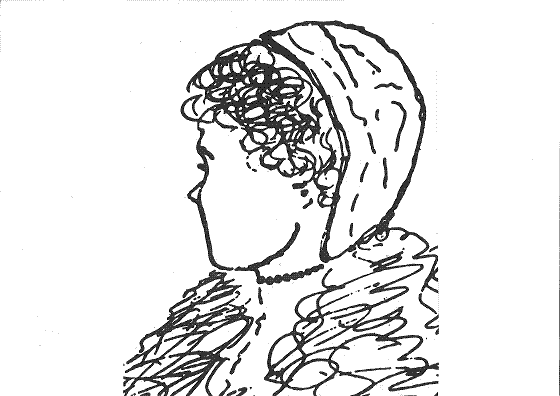
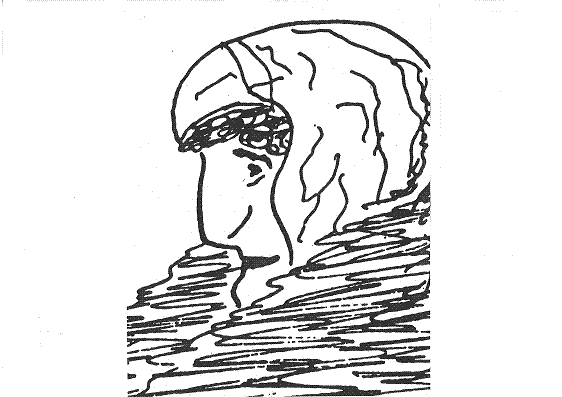
And another group a picture of an old woman…
Then he would show them both the same ambiguous image. Each group was absolutely certain they saw the “right” picture.
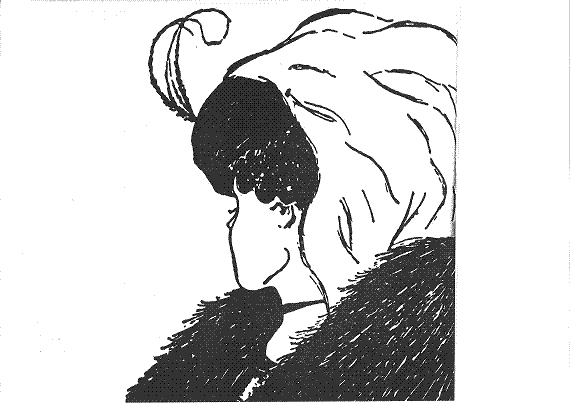
We’ve been conditioned by our experiences, our upbringing, our pain. And that conditioning shapes what we see. Covey’s conclusion:
“As clearly and objectively as we think we see things, we begin to realize that others see them differently from their own apparently equally clear and objective point of view.”
We are all walking around with paradigms we mistake for facts.
So what keeps the nail in?
Abraham Lincoln once quipped to an audience:
How many legs does a dog have if you count
the tail as a leg?
Four.
Calling the tail a leg doesn’t make it a leg.
And yet we do this constantly. Not admitting a problem doesn’t mean you’re not feeling the effects of it. Your headaches don’t care whether you’ve acknowledged the nail.
Speaking of tails — my mentor Keith, who passed away in 2012, used to tell a story from one of his son’s hockey coaches. The coach told the players: if one person tells you that you have a tail, that person is nuts. Ignore them. If a second person walks by and mentions your tail… well, you might want to take a peek. And if three or more people tell you? You have a tail.
So if we know we have a nail — or a tail, or whatever your thing is — why do we leave it there? What keeps us from dealing with it?
Am I letting past failures keep me from trying? Maybe you’ve tried before and it didn’t stick. Maybe you’ve been burned by vulnerability. The writer of Hebrews says: “Let us throw off everything that hinders and the sin that so easily entangles. And let us run with perseverance the race marked out for us.” (Hebrews 12:1). And Isaiah adds this invitation: “Come now, let’s settle this,” says the Lord. “Though your sins are like scarlet, I will make them as white as snow.” (Isaiah 1:18)
Am I afraid of what’s on the other side? Fear of change is real. You might doubt that change is even possible. Your struggle might have become your identity — who would you be without it? You might be afraid of upsetting dysfunctional relationships that have been built around the brokenness. Afraid of being found out or called out.
Here’s what I’ve learned from sitting in rooms full of people in recovery for almost two decades: change will not happen until the pain of staying the same is greater than the fear of change. That’s not a motivational poster. That’s just how it works.
What denial actually costs
In his book, Recovery: Freedom from Our Addictions Russell Brand, writing about his own recovery journey, put it this way:
“The less obvious version of addiction is still painful, and arguably worse, because we simply adapt to living in pain and never countenance the beautiful truth: there is a solution.”
That’s what denial does. It helps you adapt to the pain instead of dealing with it.
Those rooms I mentioned? That’s Celebrate Recovery, a Christ-centered recovery program. Their first lesson is on denial, which of course includes a DENIAL acrostic (If there’s one thing Celebrate Recovery loves, it’s a good acrostic), where they break down the cost like this:
Denial…
Disables your feelings. You learn to say “I’m fine” so convincingly that you stop feeling what’s actually happening inside you. Peter warned about this: “They promise them freedom while they themselves are slaves of destructive habits — for we are slaves of anything that has conquered us.” (2 Peter 2:19)
Energy lost. Maintaining the mask is exhausting. The anxiety of protecting a facade — worrying about the past, dreading the future — takes everything you’ve got. Jesus offered the alternative: “Come to me, all you who are weary and burdened, and I will give you rest.” (Matthew 11:28)
Negates growth. You are only as sick as your secrets. And you can’t get to step two if you won’t take step one. “Then they cried to the Lord in their troubles, and he rescued them! He led them from the darkness and shadow of death and snapped their chains.” (Psalm 107:13-14). God never wastes a hurt. But he can’t use it unless you step into the light.
Isolates you from God. The very first human response to sin was to hide. Adam and Eve didn’t run toward God — they ran from him. And we’ve been doing it ever since. “God is light; in him there is no darkness at all. If we claim to have fellowship with him and yet walk in the darkness, we lie and do not live out the truth.” (1 John 1:5-6)
Alienates you from relationships. We think denial is our shield, but the walls we build to keep the hurt out also keep love out. And here’s the kicker: we might be the only one in denial about our struggles. Often, everyone around us already knows. “Stop lying to each other; tell the truth, for we are parts of each other and when we lie to each other we are hurting ourselves.” (Ephesians 4:25)
Lengthens the pain. We think denial protects us from pain, but it’s like a bone healing the wrong way. The longer you wait, the harder the reset. But God says: “I will give you back your health and heal your wounds.” (Jeremiah 30:17)
Russell Brand again: ”In justifying our misery we recommit to it.” In other words, every excuse we make for staying the same is a vote to keep hurting.
Two men
I want to tell you about Jimmy and Gene.
Jimmy was my brother-in-law’s father. One blessed dude. Gene was a fiddle player and a bread man. A beloved music teacher. I had the honor of hearing both of their fifth steps — long, broken, beautiful lives. Many regrets. But neither one ever regretted stepping out of denial.
I was also at both of their death beds.
Jimmy wanted to be baptized in his hospital bed and I was given the honor. Gene — I was at his bedside in a family home that had been rebuilt after a recent fire destroyed their previous one. That rebuilt home was a metaphor for his family itself, rebuilt through recovery.
All of that happened because they took the first step. They stepped out of denial. They admitted the wreckage of their stinking thinking. They admitted their lives were unmanageable and that they couldn’t climb out alone.
The first step
Einstein said:
“The significant problems we face cannot be solved at the same level of thinking we were at when we created them.”
Or, to put it more bluntly: what got you here won’t get you there.
The first step to change is wanting to change. And the first act of wanting to change is stepping out of denial — looking at that nail, calling it what it is, and admitting you can’t pull it out by yourself.
"And you will know the truth, and the truth will set you free." - John 8:32
Step out of your denial so you can step into the unconditional love and grace that’s waiting on the other side. Yeah, the truth stings. But it’s the nail that’s been doing the real damage.
This post is adapted from a teaching I gave at Celebrate Recovery, based on their Lesson 1: Denial. The DENIAL acrostic and framework come from CR’s curriculum. If you or someone you
know is struggling, find a CR near you.