For a long time, I thought integrity meant being the buttoned-up guy who never messes up. The stuffy shirt who looks down on everyone else. Goody-goody vibes. I grew up in church, went to Christian school—I tried hard to be that guy.
In my early twenties, I read Stephen Covey’s The 7 Habits of Highly Effective People. He talks a lot about paradigm shifts—moments where you see something differently and can’t go back.
Learning what integrity actually means was one of those shifts for me. My incorrect interpretation was all about how people saw me, not about who I really was.
Covey writes: “Honesty is telling the truth—in other words, conforming our words to reality. Integrity is conforming reality to our words—in other words, keeping promises and fulfilling expectations. This requires an integrated character, a oneness, primarily with self but also with life.”
Integrated. Oneness. Wholeness. That reframed everything. And it makes more sense when you think about buildings.
What makes a building have structural integrity? It’s not any single component. It’s everything working together. The walls tie into the foundation. The framing connects with nails that have shear strength. Sheathing prevents racking. Hurricane ties secure the roof rafters to the walls. Every piece does its job, and they all align with a single blueprint.
Structural integrity is wholeness. Completeness. All the parts complementing each other toward the same purpose.
That’s the same truth Jesus pointed to, framed as a warning.
“If a kingdom is divided against itself, that kingdom cannot stand. And if a house is divided against itself, that house will not be able to stand.”
—Mark 3:24-25
That’s what personal integrity is too. It’s the alignment between what you think, what you say, and what you do, all working together like a well-built structure.
The Venn Diagram problem
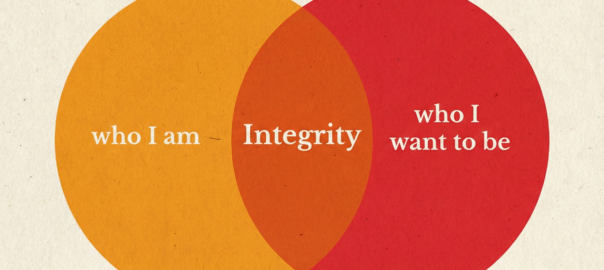
Picture two circles. One is who you want to be. The other is who you actually are. Integrity is how much those circles overlap.
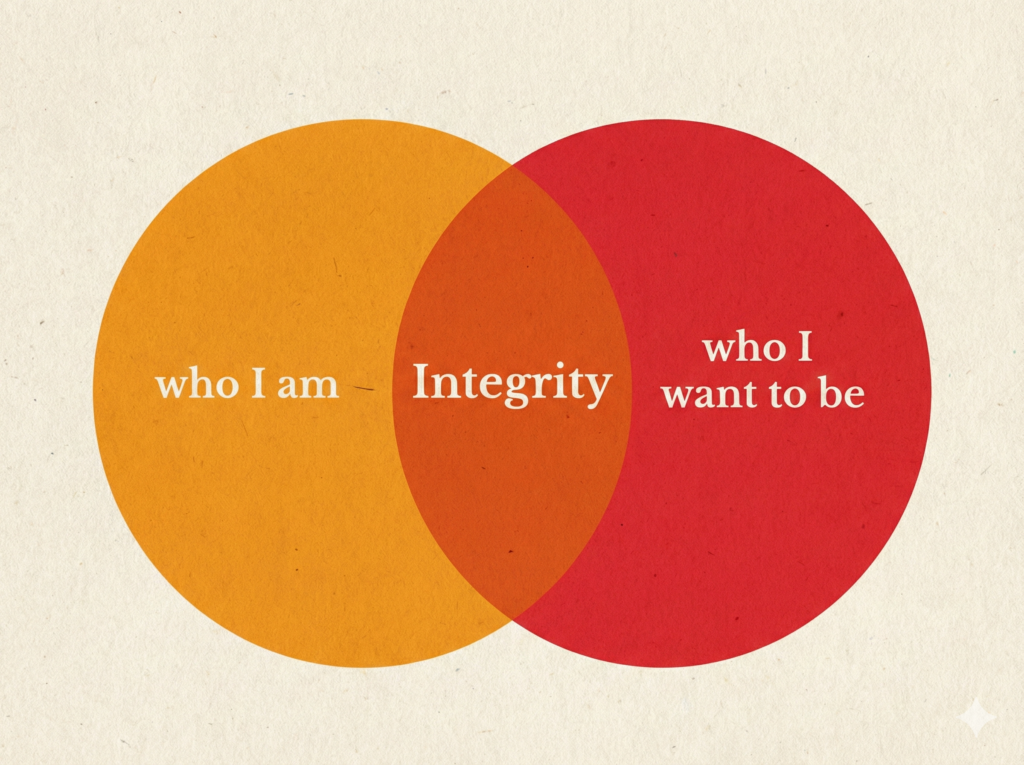
Here’s where it gets tricky: both circles can move.
If my vision of who I should be is someone who never calls in sick, never misses church, never disappoints my family, and makes a ton of money—that’s not an integrity problem. That’s a fantasy problem. No amount of self-improvement will close that gap because the target is inhuman.
Real integrity requires a realistic “who I want to be” circle. One that includes grace. When I call in sick, I make sure the people who depend on me know I’ll pick up the slack when I’m back. When I disappoint my family, I make it right or offer a wholehearted apology. A person who does those things? That’s someone I can actually become.
So the work goes both directions. Yes, grow into the person you want to be. But also, make sure the person you want to be is actually human with a healthy dependency on God’s grace. Perfectionism isn’t integrity—it’s a setup for constant failure and shame (and this deserves its own post – shame typically drives us away from integrity).
The goal is to bring those two circles closer together over time. To integrate them. To become whole.
I thought I had it figured out
In my early twenties, I had lofty visions of who I was and who I was meant to be. But my practical output wasn’t matching my self-image. When I failed my responsibilities, I didn’t take ownership. I blamed others. I deflected. “I wouldn’t have done that if it wasn’t for this thing or this situation or this person.”
And the whole time, I thought I had integrity. I thought I was honest and true.
Looking back, I see how the vision I had of myself didn’t match the version everyone else got. The two circles were barely touching.
The turning point came when I was challenged to be honest about something I’d hidden for years. I had a choice: cover it up or tell the truth. Somehow, and I credit God’s grace more than my own wisdom, I chose honesty. I confessed my struggles knowing it might cost me the relationship.
It didn’t. What it brought instead was freedom. The freedom that comes from smashing those two versions of yourself into one.
You can’t buy it by the bucket
So how do you get integrity? You can’t walk into the General Store and fill up a five-gallon bucket of it.
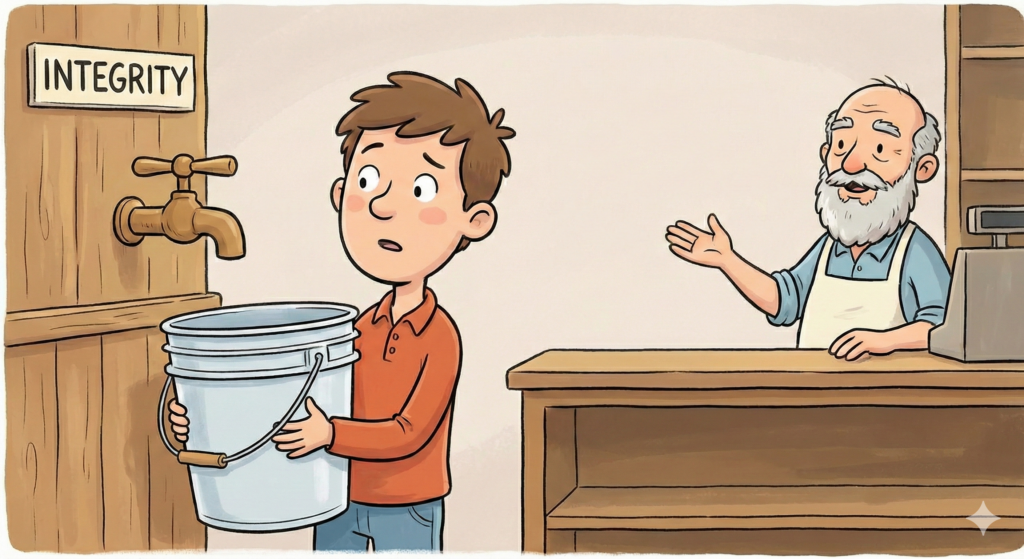
Integrity is like learning an instrument. You don’t walk onto the stage and play the hard piece. You sit in your room and play that one progression 500 times. No one wants to hear that practice. It’s not pretty. But those 500 repetitions mean that when you get on stage, you can deliver.
The same principle applies here. You don’t build integrity in the hard moments. You build it in the small ones. The hard moments just reveal what you’ve already practiced.
As Covey puts it: “Character cannot be made except by a steady, long continued process.”
If you try to exhibit integrity only when the stakes are high, you’ll buckle. That’s just human nature. But if you’ve been conditioning yourself in the small things—being honest when it’s easy, showing up when you said you would, taking ownership of small failures—you’ll have the strength when the big tests come.
This is the long game. The reaping and sowing. You plant apple seeds, but you don’t get apples the same day. You don’t even get them the same year. But if you keep planting, you eventually have an orchard.
Sometimes demonstrating integrity means losing an opportunity in the short term. You’re honest on a resume and don’t get the job. You admit you don’t know how to do something instead of faking it. The immediate payoff isn’t there.
“Better is a poor person who walks in his integrity
—Proverbs 19:1
than one who is crooked in speech and is a fool.”
But over time? The benefits compound. People know who’s trustworthy. Even people who lack integrity themselves can spot someone who has it. And they gravitate toward that person when it matters.
In my career, I’ve learned to say: “I can’t do that thing you asked me to do. I don’t know how. But I’d like to learn.” That’s real. It’s not impressive in the moment. But it doesn’t borrow from future credibility. When you project that you can do more than you can, you borrow against credibility you haven’t earned yet. And when you can’t deliver, you end up in debt.
The real measure
Integrity isn’t about never messing up. It’s about what you do when you do.
Remember the Venn Diagram—a realistic “who I want to be” includes how I handle failure. So when I mess up, I commit to making it right. I apologize wholeheartedly. I pick up the slack. I say: “That’s not who I want to be. I won’t do that again.” That’s integrity too. It’s the practice of realigning, of bringing those two circles back together.
Maybe you struggle with something hidden, like I did. Maybe your words and actions don’t match up in some area of your life. Maybe you’ve got one persona for one group and another for another.
My encouragement? Start small. But also, take some time to draw your own Venn Diagram. Be honest about where the two circles sit right now. Where’s the gap? What would it look like to move them closer together, from both directions?
Don’t expect the circles to overlap overnight. You’re planting seeds. But start the work.
Because you will reap what you sow. Laws of nature are funny like that.
This post is adapted from a conversation on the How I See It podcast. If you want the full discussion, give it a listen.