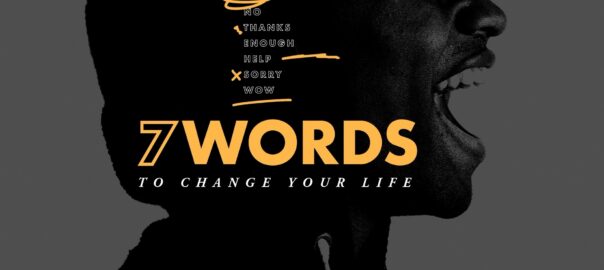
A few years ago I had the opportunity to speak at Generations Church as part of a series called “7 Words That Will Change Your Life.” My word was help. It’s a word most of us understand but very few of us are good at actually saying out loud when we need to.
I talked about the myths that keep us from asking for help, what the Bible has to say about it, and why the most important cry for help any of us will ever make is the one that changes everything.
You can watch/listen to the full talk on Generations Church’s website, or if you’d rather read it, the transcript is below.
Good morning, Generations Church! My name is Justin Sternberg. I am the ministry leader for Celebrate Recovery here, and today I am pumped because we are going to celebrate baptisms. No matter what I say here — whether you like what I have to say, or maybe my jokes fall flat — it doesn’t matter, because we get to celebrate at the end with baptisms. So I am really excited about that.
Today I get to continue our series on the 7 Words That Will Change Your Life. This whole series is geared towards life change — these are impactful words. Today I get to talk about help.
As I was thinking about “help,” I was thinking about people and situations where people don’t ask for help. The very first thing that came to mind was this idea that grown men don’t ask for help. And also toddlers. That is one thing we both have in common.
Grown men hate to ask for directions — we all understand that. We might actually be the last generation to laugh at that joke, because collectively we have handed over our man card to this thing called the GPS. We’ll let this robot lady tell us what to do, but we won’t let our wife tell us what to do, or the lady at the gas station.
And then obviously, toddlers. Every toddler hits this stage of life where all of a sudden they have this independent streak. Their catchphrase during this time is: “Me do it.” You want to feed themselves, so you let them — and of course it’s all down the front, it’s falling on the floor, and it’s painful to watch. Or you’re in a hurry, getting ready to leave the house, you’re trying to put their shoes on, and they say, “Me do it.” You’re trying to be a good parent, you’re trying to foster that independence, so you say, “Okay, you can do it.” And it is just so painful. Can I please just help you?
At the beginning of our marriage, I wasn’t that different from a toddler in a lot of ways. I didn’t like to ask for help. One thing I’ve always been notoriously bad at is finding things — some of you men probably relate, and some of you wives know what’s coming. I would search for what felt like hours for my keys or my wallet, getting so exasperated. Finally, I would go, head down, and ask Meagan: “Can you please help me find my keys?” And she would march right back to the very first place I looked — exactly where they were supposed to be — pull them out, and say, “Here they are,” every single time. I’ve had to learn to just ask for help. I could beat my head against the wall, or I could just say, “Hey Meagan, I can’t find my keys. Can you please help me?” She does the same thing. Thank you. That’s all I needed.
Asking for Your Help
I’m talking about help today, so I’m going to ask you for some help. Raise your hand to these statements.
First: How many of you would consider help to be a crucial piece of success in life? (Pause.) Okay — that is awesome.
Second: How many of you would be willing to admit that you are bad at asking for help? (Pause.) Yeah. Alright. I’m in the right place. I’ve got the right message. Let’s talk about help.
Most of us — I think 90% of the room just raised their hand to that first question — already know that help is crucial to success. We even intuit it from a young age. Back in kindergarten, they’re already assessing our ability to ask for and give help. What does the report card say? “Plays well with others.” That is the ability to give help and ask for help. We are encouraged from a very early age to give and ask for help. And yet we are still bad at it.
Why?
As I was studying this, I came across a quote I thought was pretty funny. It was from Irish author and poet Samuel Beckett. He said: “I tried to groan, ‘Help, help,’ but what came out was that of polite conversation.”
Does that resonate with anyone? You’re having a terrible day, you really could use some encouragement. Someone says, “How are you doing? Can I help you?” And you say, “I’m good.”
Or think about being at Chick-fil-A. Obviously not on Sunday — they’re closed. But you’ve got the whole family’s order on two trays: five drinks, chicken sandwiches, fries. You’re carrying both trays through the store, being very careful, and every once in a while one tips and a little drink spills. As you walk past someone, they see the pain on your face and say, “Can I help you with that?” And you say… “No, I’ve got it. I’m good.”
Why are we so bad at asking for help?
The Six Help Myths
I have a few theories. I call them The Six Help Myths.
Myth #1: The America Myth
The myth is this: Living the American dream, there is nothing I can’t do with a little ingenuity, blood, sweat, and tears — with my pet bald eagle at my side. It is the American spirit, the can-do thing. I don’t need help. I can figure it out.
But here is the reality: sometimes hard work just digs you further into the hole you’re already in. You just keep digging, working really, really hard — and you’re only getting deeper and deeper into your problem.
Myth #2: The Superhero Myth
This is the idea of I have to be just like X person — the superhero in my mind. Whether it’s your dad, your grandfather, your aunt, your mom — somebody who is larger than life, who clearly has it all figured out. They are your example. The person you think, I have to aspire to be. I have to live up to that example.
But here is the reality: even superheroes ask for help. Think about any of the last several Avengers movies. Almost every single one, they are recruiting a new Avenger. These are world-class superheroes who can save the world with a single pinky finger — and yet they need one more Avenger this time around. Even superheroes need help. But even more crucially, the reality is that superheroes are fictitious.
Myth #3: The “Never Let Them See You Bleed” Myth
This comes from sports. It’s the myth that I can’t exhibit even an ounce of weakness, or the competition will defeat me. I have to look strong. I can’t show any weaknesses.
But even in sports, we rely on the help of teammates and substitutions. Most athletes can’t play the whole game. Even in car racing, they depend on pit stops — someone to help change their tires and refuel. The problem with this sports mentality is the idea of scarcity: there is only one winner, only three podium spots. But in God’s economy, that is not how it works. There is abundance.
Myth #4: The Instagram Myth
The myth is: Those people have it all together. I need to keep up with the Joneses.
The reality is we are comparing the false-reality glamour shots on someone else’s feed with our own worst moments, and thinking that person has got it all together. And to keep up, we do the same thing — we project those glamour shots onto our own feeds and say, “I’ve got it all together too.”
Here’s the thing: everybody needs help sometimes in life. This is just part of the human experience. Help does not often show up in our social media feeds. You’re not often going to see someone post: “Today I asked for help. My wife found my keys for me. I am so thankful for her.” But you should do that.
Myth #5: The White Knuckles Myth
The term “white knuckles” comes from the recovery community. It is the idea that if I just try hard enough, I can quit. I have what it takes inside of me. I just haven’t tried hard enough.
The truth is: we can’t white knuckle forever. We will reach our limit.
Everybody has strengths, and everybody has weaknesses. Not only that, but there are seasons in your life — summers when things are going well, things are growing, things are great. And then winters, when things are dying, things are leaving. You can’t always be at the top of your game. There are also unexpected injuries — unpredictable events that come into our lives and suddenly we can’t produce like we used to. Those white knuckles are not going to cut it.
This is very personal for me, especially around the seasonal thing. I struggle with what is called seasonal affective disorder — seasonal depression. Every fall, something triggers in my system. I think it might be the days getting shorter, the darker days, things falling and dying. Something triggers in my brain and I struggle with feeling down. I struggle with looking on the bright side of life. I can show you a stack of journals full of prayers that say, “God, help me with this” — and I still need help. I need his help, but I also need prayers from others. Sometimes medication is exactly the help you need. Sometimes you need psychological help. Sometimes you need prayers from others.
The danger is this: most people can white knuckle for a time — and that’s exactly where denial sets in, because it makes you think you can do it on your own. Think about any movie where someone is hanging from a cliff or a skyscraper. You can literally see them zoom in on his knuckles — and they’re white. He’s hanging on. “I got this.” And then you see it start to slip. Oh no. And always, one of two things happens: either he falls — bad news — or someone swoops in and grabs him, right at the moment he’s about to let go. And guess what that is? Help.
Myth #6: The Self-Help Myth
The myth is: “The Lord helps those who help themselves.” How many of you have heard this? Guess what — you cannot find that in the Bible. It’s not there.
The dictionary definition of help is a verb: to make it easier for someone to do something by offering one’s services or resources. There’s nothing about me there. “The action of helping someone to do something. Assistance. An exclamation used as an appeal for urgent assistance.” Help, I’m drowning! — Don’t worry, I’ll just swim! That’s self-help.
Now, I’m not knocking self-help books. If you walk into a bookstore or library, there are huge sections full of them, and they are amazing resources — because it is somebody else offering their help, their assistance, from something they’ve been through. They’re helpful books. But do you see the idea? We can’t accept help unless we frame it as doing it ourselves. Self-help books are written by someone to help you — but in order for you to buy it, read it, and want to consume it, they have to trick you into thinking you’re doing it yourself. That’s how bad we are at asking for help.
The Truth About Help
Okay, we’ve talked about myths. Now I’m going to move into truth. The truth is found in one source: God has given us his Word, the Holy Bible, and that is where we can find the absolute source of truth.
All throughout the Bible, you’ll find that help is an integral part of God’s economy.
Truth #1: Not asking for help is a big problem — because of pride.
The Bible has a lot to say about pride. Proverbs 16:18 says:
“Pride goes before destruction, and haughtiness before a fall.”
Not asking for help is a big problem. Pride tricks us into thinking we have the whole picture, that we can figure it out.
And there’s more bad news. Proverbs 14:12 and 16:25 — Solomon said it twice, so it was that important:
“There is a path before each person that seems right, but it ends in death.”
I can’t just depend on my own thoughts. I need help.
When it starts to affect your life — when it starts to impact your family members because you’re unwilling to ask for help — it switches from a cute quirk to something more serious. We don’t want to live there.
Truth #2: We have a higher power, and he wants to help.
In the recovery community, a higher power is this idea that I am powerless to change things inside of myself. I can’t white knuckle long enough to solve my problems. I have to depend on something greater than me. At Celebrate Recovery, we name that higher power. We call him Jesus Christ. He can come into my life and save me. He can help me. He can be my higher power.
Proverbs 3:5-6 says:
“Trust in the Lord with all your heart. Do not depend on your own understanding. Seek his will in all you do, and he will show you which path to take.”
Matthew 7:9-11, Jesus says:
“You parents — if your children ask for a loaf of bread, do you give them a stone instead? Or if they ask for a fish, do you give them a snake? Of course you don’t. So if you sinful people know how to give good gifts to your children, how much more will your Heavenly Father give good gifts to those who ask him?”
His help is also a win-win situation. Not only does he help us, but he gets glory out of it. Paul talks about this in 2 Corinthians 12:8-10. He’s talking about a thorn in the flesh:
“Three different times I begged the Lord to take it away. Each time he said, ‘My grace is all you need. My power works best in weakness.'”
He didn’t say, “What’s wrong with you? Get yourself fixed up.” He said, “My grace is sufficient, and my power works best in your weakness.”
“So now I am glad to boast about my weaknesses so that the power of Christ can work through me. That’s why I take pleasure in my weaknesses — in the insults, the hardships, the persecutions, and the troubles that I suffer for Christ. For when I am weak, then I am strong.”
Food for thought: if I haven’t learned to ask God for help, there’s a pretty good chance I’m not good at asking others for help either. That’s step one — we need to become good at asking God for help. He is the giver of good gifts.
Truth #3: We have a community, and community was made for help.
Solomon talks about this in Ecclesiastes. He takes the idea of success and flips it on its head:
“I observed yet another example of something meaningless under the sun. This is the case of a man who is all alone, without a child or a brother, yet who works hard to gain as much wealth as he can.”
He asks: “But then who am I working for? Why am I giving up so much pleasure now? It is all so meaningless and depressing.”
Then he says:
“Two people are better off than one, for they can help each other succeed. If one person falls, the other can reach out and help. But someone who falls alone is in real trouble. Likewise, two people lying close together can keep each other warm, but how can one be warm alone? A person standing alone can be attacked and defeated, but two can stand back to back and conquer. Three are even better, for a triple-braided cord is not easily broken.”
Help equals safety. And it also equals sharpening. Proverbs 27:17:
“As iron sharpens iron, so a friend sharpens a friend.”
Community is so important. This is why at Generations Church we push for community all the time — small groups, Celebrate Recovery, open share groups, volunteering. You can join a community of other believers who are, guess what? Helping. You’re helping other believers help. That’s double help — definitely a good thing.
Truth #4: We are a community, and we were made to help.
Proverbs 3:27-28 says:
“Do not withhold good from those who deserve it when it is in your power to help them. If you can help your neighbor now, don’t say, ‘Come back tomorrow, and then I’ll help you.'”
Let me revisit what I call the Peter Parker Principle. When Uncle Ben was dying and Spider-Man was there watching him, he said: “Remember this, Peter — with great power comes great responsibility.” Did you know that saying is actually based on a biblical principle? It comes from Luke 12:48:
“When someone has been given much, much will be required in return. And when someone has been entrusted with much, even more will be required.”
We’ve been given so much. God has blessed us in so many ways that he expects us — he desires for us — to take the help we’ve been given and turn around and pass it on to the next person. It’s called giving back.
The Most Important Cry for Help
As I close, I have to say something. As I was studying this topic, God convicted me. I can’t talk about asking for help — asking God for help — without talking about the single most important cry for help we can ever make in this life:
The cry for salvation.

Do you recognize this symbol? SOS. It’s the most universal symbol for asking for help. Across the globe, if you see that on a beach, the whole world knows what it stands for. But do you know what SOS stands for? Save Our Ship., or more commonly… Save Our Souls.
Here’s the thing — there is no Coast Guard boat, no helicopter, no daring rescue swimmer that can accomplish that feat. They might save your life, but they have no power to save your soul.
Here’s the bad news first: we’re all shipwrecked. We have no opportunity for saving except for one.
Romans 3:10 says: “No one is righteous — not even one.”
Romans 3:23 says: “Everyone has sinned. Every single person, no matter what myth you fall under, falls short of God’s glorious standard.”
That means you don’t have what it takes to save yourself. There is no self-help that can get you out of this situation.
But God sent a rescue boat, and he tossed a lifesaver. Nobody can be good enough — perfection is good enough, and how many of us can be perfect?
“For the wages of sin is death, but the free gift of God is eternal life through Christ Jesus our Lord.”
The free gift. He’s offered his help through Christ Jesus our Lord. God showed his great love for us by sending Christ to die for us — even when we didn’t write SOS in the sand, he still sent the rescue boat. He tossed the lifesaver toward us. This is our higher power, Jesus Christ, pulling off the greatest rescue of all time — not merely saving our lives, but our souls. Saving us from spending eternity apart from him in a place the Bible describes in no uncertain terms: a place called hell.
But this astounding rescue requires only a simple SOS.
How do you send it?
This SOS is:
- An admission that I need a higher power to rescue me, because I am incapable.
- An understanding that Jesus Christ is that higher power.
- A belief that through his sacrifice — his death on the cross, his perfect payment for my sins (past, present, and future) — he has already tossed that lifesaver in my direction. All I need to do is grab onto it for dear life, for the saving of my soul.
Romans 10:9-11 says:
“If you openly declare that Jesus is Lord and believe in your heart that God raised him from the dead, you will be saved. For it is by believing in your heart that you are made right with God, and it is by openly declaring your faith that you are saved. As the Scripture tells us, anyone who trusts in him will never be disgraced.”
Today we are doing baptisms, and they are going to do just this — openly declare that Jesus is their Lord, and believe in their heart that God raised him from the dead.
He is willing, available, and ready to rescue. If you are ready to accept this help, this offering, and grab onto that lifesaver, you can pray this prayer with me right now.
Prayer of Salvation
Before I pray, I’m going to ask for help one more time. For every one of you who has already done this — who confesses Jesus as your Lord, who believes he is your higher power — I’m asking you to pray right now. Pray for those in this room who have not yet done that. Help me pray that the Holy Spirit would move in their heart, and that they would be ready and willing to give their life to the higher power, Jesus Christ.
Pray with me:
Jesus, here and now, I am coming to grips with the eternal consequences of my sin, and that there is nothing I can do to earn right standing with you. I am confessing my need for you as my eternal rescuer, and I am accepting your incredible offer of salvation and the opportunity to spend forever with you in heaven. I accept and believe that you can and will save me from my sin and the eternal consequences of those sins. And finally, I accept you as the Lord of my life and surrender my will to yours.
And Lord, for those of us who are your children — new and old — help us to ask for your help. Help us to depend on you daily, in a desperate dependence on you, to bring us where we need to go. Help us to recognize you as our Heavenly Father who is ready to give good gifts to those who ask. Help us to look for opportunities to help others. Help us to build a community where there is safety in numbers and where we can help each other out.
In the name of my Lord and Savior, Jesus Christ. Amen.
This is a transcript of the talk “7 Words To Change Your Life: Help” given at Generations Church. Minor edits have been made for readability.